The Front Said T-Mobile. The Block Was Always Verizon.
We have written before about changing the identity layer at the registrar, nameserver, and WHOIS surface. The levers are familiar: transfers that rewrite the “brand” of the registration, NS changes that alter passive-DNS history, contact hygiene that overwrites earlier strings, and aging that adds chronological weight. Those operations sit in a compartmentalized system. The public face can be mutated while the underlying allocation remains untouched.
The same compartmentalization exists one layer down, at the IP-block identity surface.
The observation
On 5 August 2026 our own report labeled the client IPv6 prefix 2600:1010:b204:… as T-Mobile-style. The phone that originated the traffic has only ever been a Verizon device, original owner. The backend allocation record has said Verizon since 2010. The front of the identity stack and the back of the identity stack disagreed.
That disagreement is the subject.
Backend (the registry layer)
ARIN for the space:
NetRange covers 2600:1000::–2600:1017:ffff:…
NetName WIRELESSDATANETWORK
Organization Verizon Business (MCICS)
Registration date 2010-04-06
Net last updated 2022-05-31
Organization record last-changed 2026-08-10
This is the authoritative allocation. It has never left Verizon Business. There is no T-Mobile registration window on the RIR for this prefix.
Frontend (the display layer)
From October 2025 through the date of discovery, intelligence harvested against the prefix continued to present the frontend identity as T-Mobile. The hard layer (ARIN allocation + the IRR objects last-modified 2025-10-28) already carried Verizon Business. The soft layer did not. Asname and geo feeds collected inside that window — including the material that informed our own 5 August 2026 report — still emitted T-Mobile / T-Mobile-style. Only the live pull on 21 August 2026 forced the frontend into alignment:
Team Cymru returned AS6167 CELLCO-PART – Verizon Business, US for the more-specific prefix.
RIPE prefix overview returned AS22394 CELLCO – Verizon Business.
ARIN remained unchanged: Verizon.
The frontend was altered. The block itself never moved.
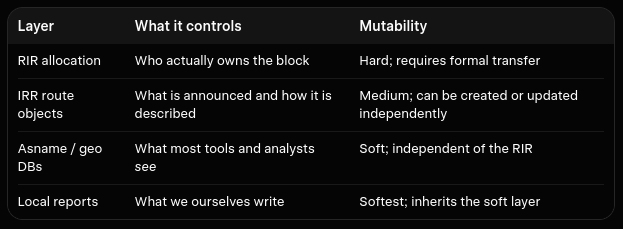
Compartmentalized identity
This is the same pattern we described for domain identity, only applied to address space.
The altered frontend
From October 2025 through the date of discovery, intelligence harvested against the prefix continued to present the frontend identity as T-Mobile. The hard layer (ARIN allocation + the IRR objects last-modified 2025-10-28) already carried Verizon Business. The soft layer did not. Asname and geo feeds collected inside that window — including the material that informed our own 5 August 2026 report — still emitted T-Mobile / T-Mobile-style. Only the live pull on 21 August 2026 forced the frontend into alignment (Cymru AS6167 CELLCO-PART Verizon Business, RIPE AS22394 CELLCO).
The frontend was altered. Within the October 2025–present window the display layer kept presenting the older carrier identity even while the registry layer did not. That is the identity-layer finding: in a compartmentalized system the soft layer can be changed (or can remain changed) independently of the hard allocation, and that altered frontend is what most tools and analysts actually consume until someone forces a live registry check.
Defensive corollary
When the identity of an address block matters, the same compartmentalization that allows the soft layer to diverge also creates different operational risks depending on who is looking.
Defender / security operations
Start at ARIN (or the relevant RIR). Treat the allocation record as ground truth. Treat asname, geo, and commercial IP-intelligence feeds as frontend only. Any detection, enrichment, or blocking logic that keys primarily on the soft label inherits the risk that the label is stale or deliberately altered. Document the discrepancy when it exists rather than papering over it with the softer name.
Analyst / threat-intelligence standpoint
Asname and geo databases are convenient but secondary sources. When a prefix is attributed to a carrier, record both the soft label and the hard registry object, including the date of the IRR objects and the date the soft feed was harvested. A multi-month window in which harvested intelligence continued to present one carrier while the registry already carried another is itself an observable. Treat that lag as part of the identity surface under examination, not as noise to be normalized away.
Law-enforcement / investigative standpoint
Attribution that rests on the frontend identity of an address block is only as strong as the currency of the soft-layer data used. In any matter where carrier identity, roaming claims, or the apparent operator of a wireless prefix is material, the registry record (ARIN/RIR) and the contemporaneous asname/geo harvest must both be preserved and compared. A soft label that remained altered for months after the hard records already reflected a different operator can create false investigative leads or undermine later assertions about who controlled the space at a given time. Live registry pulls, dated intelligence extracts, and clear separation of frontend versus backend identity should be standard practice before carrier attribution is treated as established fact.
In all three roles the principle is identical: the registry is the block. Everything else is presentation. In a compartmentalized system the presentation can be changed — or can simply remain changed — without ever touching the allocation that actually matters. The only reliable resolution is a live query against the hard layer.
Quantitative Security. Attribute the tool, then the tenant, then the registry — in that order.